
There’s value in financial therapy for men of wealth and power.
Do billionaires need financial therapy? The very idea probably seems ludicrous. Why would someone with such immense wealth and power have issues around money?
That question is one of the topics addressed in a new book, Financial Therapy for Men, edited by Dr. Prince Sarpong. The book includes contributions from an international group of financial and therapy professionals. (I am one of them.) It explores the psychological, societal, and cultural factors that shape financial behavior for men.
In an article published last year in The Conversation, Dr. Sarpong points out one reason why financial therapy can be especially important for wealthy and successful men: their financial choices have a broad impact. When those with financial power make decisions, the consequences can ripple through organizations, industries, and markets.
Financial stress among wealthy men often presents as dominance, overwork, or compulsive acquisition. These behaviors may pass as confidence. However, they are often emotionally reactive, driven by protective internal parts shaped by painful early experiences.
In high-performing men, common protector parts include those that suppress emotion, pursue relentless productivity, and frame vulnerability as danger. Beneath these protectors are often younger internal parts wounded by childhood factors like conditional love, emotional absence, or instability. These parts have internalized beliefs such as “love must be earned” or “never show weakness.” Unacknowledged pain tied to such unconscious beliefs can lead to fear-based decisions with sometimes costly consequences.
In 2023, psychologist Jens Mazei and his team found that men negotiating in stereotypically masculine domains, such as salaries or business deals, become more aggressive when their masculinity is threatened. They are less likely to compromise and more likely to frame decisions competitively. In finance, this pattern may drive riskier bets, excessive leverage, or ego-based mergers.
Suppose a CEO is negotiating an acquisition. He believes the company is worth $500 million, but the seller is holding firm at $550 million. For the CEO, risking losing the deal by sticking to $500 million can feel like weakness. Agreeing to $550 million can feel like strength, a signal that he got the deal done. His need to avoid appearing weak could redirect $50 million in shareholder capital, perhaps needlessly. Real money would be spent because of an unconscious need for reassurance rather than a clear assessment of value.
Financial therapy can help men explore their internal parts to learn to recognize and begin to heal the emotional beliefs driving their economic behavior. The point of financial therapy is not to dampen ambition, but to heal beliefs that may be souring it. Ambition driven by unconscious needs to prove one’s value, equate money with safety, or conflate net worth with self-worth can carry a high personal cost in stress and a lack of genuine fulfillment. For men in power, it can also take a financial toll on the organizations and people they lead.
With financial therapy, such men can uncover the protective good intentions of their internal parts, which often have little to do with money. They are more commonly about grief, anger, fear, and disconnection from others. Such emotions and vulnerability can be hard to acknowledge for men, especially in cultures where masculinity is equated with strength and stoicism.
Yet the greater vulnerability may be the failure to address a leader’s issues around money. Public companies led by reactive executives can distort markets, drive up costs, and destabilize retirement portfolios.
Financial therapy for those at the top, then, is not indulgence or privilege. It is institutional risk mitigation. A powerful man with the courage to look inward for personal healing can enhance emotional and financial wellbeing for many other people, even as he builds it for himself.
Rick Kahler, CFP, is a fee-only financial planner and financial therapist with a nationwide practice, Kahler Financial Group, based in Rapid City. His co-authored books include “Coupleship Inc.” and “The Financial Wisdom of Ebenezer Scrooge.”
The information provided is for educational purposes only and should not be construed as investment advice. The views expressed are subject to change based on market or economic conditions. Past performance is not indicative of future results. Any reference to potential benefits is illustrative and may not apply to your individual circumstances. You should consult with your financial adviser before making any investment decisions. KFG, LLC is an SEC-registered Investment Adviser.
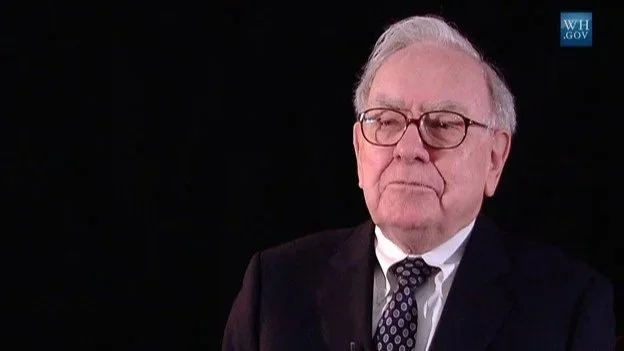
Photo: Warren Buffet, public domain, wikimedia commons
The South Dakota Standard is offered freely and is supported by our readers. We have no political or commercial sponsorship. If you'd like to help us continue our mission to advance independent political and social commentary, you can do so by clicking on the "Donate" button that's on the sidebar to your right.