
Times are changing. Ranching is going, going – but not quite gone.
Editor’s note: This essay has been revised and updated several times, appearing in various incarnations in “Writers on the Range”; the syndicated column published by High Country News. In slightly different form, the essay also appeared in Between Grass and Sky: Where I Live and Work, University of Nevada Press, 2002. The Standard thanks Ms. Hasselstrom for letting us share it here.
Do you hear fiddle music as the last rancher rides off into the sunset? Many people think ranching is doomed, if not already buried. If ranchers want to avoid extinction, they need to consider their responsibilities as well as their rights.
The traditional rusty pickup is being displaced by double-cab outfits or Hummers. The value of agricultural land is altered each time ranches are diced into subdivisions. And no one is talking about water, the silent partner in any speculation about the future.
The first neighborhood rancher sold his ranch for double the tax assessment and related the news with a satisfaction. Loitering in the aisles while the owner of our local grocery store added costs in her old gray head, shoppers muttered to one another. “Did ya see that house them new people are building? Bigger than the town hall.”
We chuckled wisely at the old saying that we’d all make more money if we sold the land, put the money in the bank, and lived off the interest.
Gossip turned to bellyaching once we realized how much our neighbor’s windfall was going to raise our taxes by increasing the assessed value of the land. Each ranch sold made all the surrounding ranches “worth more”--but only if they sold. We congratulated canny ex-ranchers as they moved to Arizona. No one mentioned that making money without working went against everything we believed.
We griped about speeding construction vehicles on dirt roads, and lamented the number of deer, rabbits, badgers, and coyotes run over. Shrugging, we repeated clichés: “Got to get bigger to get better. It’s progress; what can you do?”
Nowadays we don’t stand around chatting. We toss remarks over shoulders as we fill our go-cups in the new combination gas station/bar/café on the highway. Newcomers occupy every hilltop in sight, beginning to notice how the wind piles snowdrifts in front of their garage doors—if they’re here in winter.
Property taxes are so high our grandfathers are spinning in their graves, but the new highway makes trips to town easy, a good thing since many of us have jobs there.
Instead of stocking up on groceries once a month, we pick up something for dinner at the deli on the way home. We don’t buy anything but our daily coffee fix at the station on the highway, but we like tourist dollars in the little town’s treasury now that we need more deputies and a town marshal to catch the speeders, and isn’t that regular trash pickup handy? Shame old Anna died before she had a chance to enjoy her retirement after she closed the grocery store. Gotta run!
Some cynics predict that the recalcitrant old ranchers will be replaced by politically correct tofu eaters others think the West will be knee-deep in garbage shipped from the east coast. Tourism has moved ahead of agriculture as the primary business; construction companies can’t keep up with the demand for convenience stories and parking lots.
A few activists want an open range from the Canadian border to southern Texas, unfenced and filled with bison and wolves. One group even wants to bring back the woolly mammoth but would settle for elephants.
I can visualize a future where bison chase bicyclists along paved roads and suburbs cover the prairie. Folks on ATVs and ORVs and other alphabetical recreational transport aim movie cameras at a couple of lean wolves trying to get a little privacy behind the last sagebrush. Joggers in bright orange elastic underwear pause to scrape elephant dung off their Nikes.
By contrast, in my ideal future, ranching would remain the backbone of the arid shortgrass plains for simple economic reasons that affect those who prefer tofu as much as we meat-eaters. Millions of years of evolution have developed plants best suited to the Western landscape. The best way to harvest their bounty is--so far--inside a grazing animal, and the most practical grazer to raise is a cow.
Ranchers and newcomers need to work together to keep ranching alive. For starters, we might teach people who move into ranching communities how to get the most from their new homes. Just as we instruct new residents on the dangers of weather and wildfire, let’s educate them on the meaning of a ranching community, something they came here to find.
Properly trained, new residents might provide a means to revitalize ranching country economically and philosophically while appreciating the history, personalities, and conservation work of long-time ranchers.
The rural western Dakota ranching community where I grew up still enjoys qualities cherished by the pioneers who settled there in the 1800s. Many of us still don’t lock our doors or take keys out of our pickups. This habit isn’t just because we are trusting, but because a neighbor or stranger might need to come in to use the phone or might need to borrow a pickup in an emergency.
Agreements can be sealed with a handshake, and spring branding is a traveling potluck as families help each another. “The check is in the mail” usually means someone put it in your mailbox without a stamp. As my neighbor Margaret always said, “Neighbor is a verb.”
Rural communities might adopt an idea from Driggs, Idaho, where a friendly handbook (available online) helps strangers become informed residents by offering information on soil, wildlife, water rights and weeds. The chapter on grazing, for example, provides specific tips on native vegetation, riparian management, livestock rotation, and fencing methods and customs, as well as suggesting how to be a responsible horse or dog owner and to burn trash safely.
As for ranchers, they need to start saving their own skins by figuring out how to make money, legally, without having to do any more work. One solution might be to devise ways to charge for labor they already do in the course of running sustainable ranches wisely: ranchers preserve wildlife, native grasses, and open space.
Beyond that, they might have to change some long-held beliefs, consider learning new ways to preserve prairie life. Forty miles south of my ranch, NO ZONING signs decorate fences through a pretty valley. New houses spring up every week as ranchers exercise their right “to do what I want with my own land.”
Those ranchers would probably agree that rights require responsibility. They may even realize that other western communities have chosen to prohibit development in terrain best suited to grazing. If Western ranchers decide not to decide, they will give up their right to choose their future. They may sacrifice the “right” to ranch.
They’ll be like that rancher who came into the bar and started downing whiskies. When a sympathetic friend asked him what was wrong, he shook his head in despair. “Some blankety-blank Californian took my ranch away from me.”
“But how could that happen?” “The so-and-so met my price.”
If ranchers want to avoid exiting the Western stage—to the sweet strains of that fiddle, of course—they need to be their own best friends. That means making tough choices. “The only thing necessary for the triumph of evil,” as Edmund Burke said, “is for good men to do nothing.”
© Linda M. Hasselstrom. Reprint with permission only.
South Dakota rancher Linda M. Hasselstrom writes poetry and nonfiction. She is the winner of numerous awards.
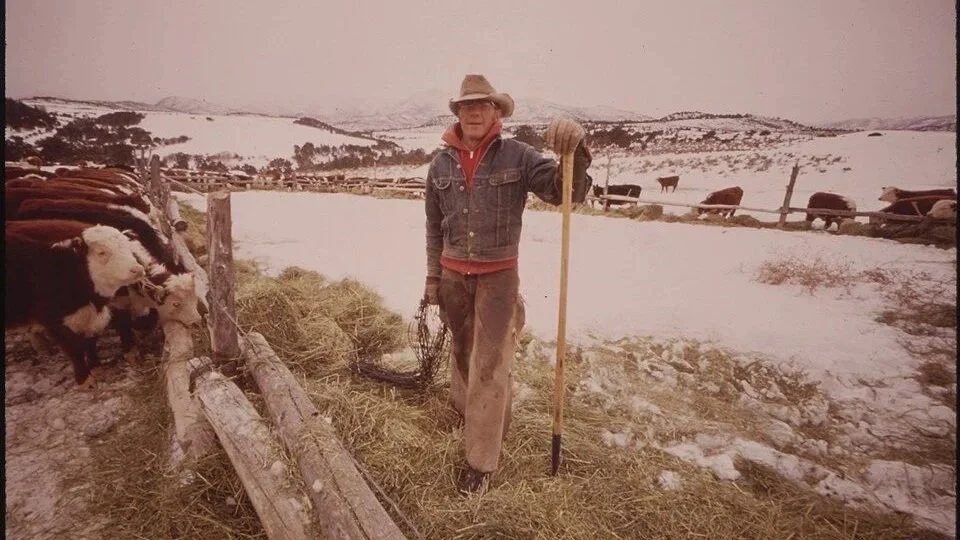
Photo: Colorado rancher, 1972, public domain, wikimedia commons
The South Dakota Standard is offered freely and is supported by our readers. We have no political or commercial sponsorship. If you'd like to help us continue our mission to advance independent political and social commentary, you can do so by clicking on the "Donate" button that's on the sidebar to your right.
Follow us and comment on X and Bluesky