
My SDSU history prof told of singing along now, regretting it later. Will people admit to their loyalty in the future?
He was a young man stationed in Germany around 1960, dating a local girl. She invited him to a family gathering.
It was a festive time, which usually means plenty of beer was served. As the night wore on, people celebrated and drank more, and started to sing. At first, it was popular songs of the time, followed by ones they remembered from days gone by.
The young American soldier grinned and drank, and enjoyed the entertainment. Then, he recognized one of the tunes — “The Horst Wessel Song.”
The Germans, filled with beer and memories, were belting it out until their eyes turned to the American in uniform seated among them. The song slowed, and then stopped.
“The Horst Wessel Song” was the co-national anthem of the Nazi Party from 1930-45. Wessel was a member of the Sturmabteilung (SA), the paramilitary wing of the Nazi Party. He was a fervent admirer of Adolf Hitler and used violence and threats to accomplish his political goals.
Wessel was shot, possibly by communists, maybe just for unpaid rent, on Jan. 14, 1930, and died of sepsis on Feb. 23, 1930. But he was not forgotten.
The Nazis turned his song into a rallying cry, and portrayed Wessel as a martyr.
Three years after his death, Hitler spoke at his grave. Horst Wessel, a thug who died violently at the age of 23, was elevated to the posthumous role of national hero. The song he wrote was heard across the Third Reich.
After World War II, his grave was vandalized and his remains, and those of his brother, were removed and damaged. Officially, Wessel had been given his proper historical assessment. He was a thug who should be forgotten.
But at that family gathering, when those Germans who had been young during the war, had enough beer in them, his song was on their lips. They all knew it and sang it with great enthusiasm.
I heard this story from an SDSU history professor who was that young soldier. He told it to a class two decades after witnessing it, and it’s been on my mind in recent years. Even if people come to their senses and understand the implication of their political choices, they often still retain a fondness for the “good ol’ days,” no matter how horrid they actually were.
The professor said the song ended as people saw the American soldier in their midst. Over the next hour or so, people sidled up to him and said, “Oh, I WASN’T a Nazi. Other folks supported them, but not me.”
Over and over, he heard the same story. They were against Hitler, of course. Never liked what he stood for and what he did.
The professor said he understood what they were trying to tell him. They were not to blame for the horrors unleashed by Hitler and his nation of supporters. It was other people.
Sure, they knew “The Horst Wessel Song,” and could still sing it with tremendous enthusiasm, but they didn’t really think that way.
When he told us this around 1980, the professor was typically kind and understanding. They were nice folks, he said, inviting him into their midst for food, beer and good times.
But even nice folks can become tools of evil. They can get swept up in national pride, or what they think it is, and back a leader who stands for absolutely terrible things and advocates dangerous policies.
The banality of evil can and does exist. I wonder if some day down the road, millions of Americans will tell people they didn’t really support those policies. They didn’t vote for or back their leader.
They were just singing along.
Fourth-generation South Dakotan Tom Lawrence has written for several newspapers and websites in South Dakota and other states for four decades. He has contributed to The New York Times, NPR, The London Telegraph, The Daily Beast and other media outlets. Do not republish without permission.
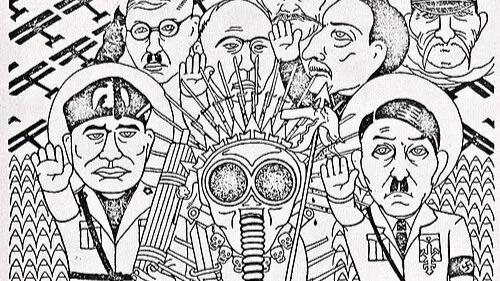
Photo: lineup of the world’s dictators, public domain, wikimedia commons
The South Dakota Standard is offered freely and is supported by our readers. We have no political or commercial sponsorship. If you'd like to help us continue our mission to advance independent political and social commentary, you can do so by clicking on the "Donate" button that's on the sidebar to your right.
Follow us and comment on X and Bluesky