

Retired SDGF&P officer: Translocating bighorn sheep is the most expensive wildlife experiment in S.D history
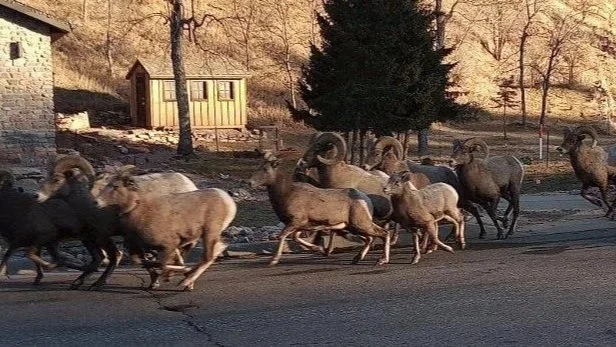
Editor’s note: I posted the above pic on my Facebook page. It’s a herd of bighorn sheep crossing a main thoroughfare in Rapid City. Among the responses was the following from John Wrede, a retired South Dakota Game, Fish and Parks conservation officer. Some background on the history of translocation of bighorn sheep to South Dakota can be found here.—John Tsitrian
Translocating bighorn sheep from the western United States and Canada has been the most expensive wildlife experiment in SD history.
Consider the descendants of the Georgetown, Colorado, herd that had spent most of its time along I-70 interfering with traffic and being a general nuisance. These critters are simply living the learned behavior of their Colorado relatives, becoming traffic hazards rather than being the remote mountain dwellers characteristic of the remainder of their brethren in the Rocky Mountain West.
Then there is the herd that lives in Deadwood, imported from Alberta, Canada, that lived along the highway in Banff! They are, basically harmless unless you choose to try and pet them.
The entire object of both those translocations was to establish a viable, trophy huntable population of animals on public lands in the Black Hills. GFP sold this idea to the public on the notion that these populations, once fully established, would support 16 trophy hunting licenses each year. (Editor’s note: Per a phone call to GF&P, a total of six licenses at $300.00 each were sold in 2025.)
In more than 20 years, hunting license revenues have come nowhere close to expectations and likely never will. In both translocations, the costs exceeded $80,000 each with full intentions of both herds, those in Rapid City and in Deadwood, developing quickly.
What we also knew is that the pneumonia die off in Custer State Park beginning ins 2004 would also likely occur with these populations; particularly the Deadwood Group because of the proximity of domestic sheep. Sure enough, catastrophe happened. In 2005, an estimated 90 percent of the bighorn sheep in the Black Hills perished, decimated by an outbreak of bacterial pneumonia.
The only truly viable Big Horn population we have that resembles a wild bunch is found on Elk Mountain in the far southwest section of Custer County that borders Wyoming. Sometimes they're in South Dakota, sometimes they're in Wyoming, where they aren’t hunted simply because of the small, barely viable population.
I can't begin to identify the costs associated with research trying to determine how to extirpate the pneumonia organisms that cause lamb and adult mortality at alarming rates in these animals, but it approaches over half a million dollars and more. So, what these animals turn out to be is a tourist attraction more than anything else, just like the band in Badlands National Park that also have seen at least three severe die-offs, primarily due to pneumonia and other density dependent diseases.
It's the reason why I said they are the most expensive experiment in our history, one that keeps on costing lots of money.
John Wrede is a retired South Dakota conservation officer. He retired from SDGF&P in February 2007 with 31 years of service to the state of South Dakota.
Photo: John Tsitrian
The South Dakota Standard is offered freely and is supported by our readers. We have no political or commercial sponsorship. If you'd like to help us continue our mission to advance independent political and social commentary, you can do so by clicking on the "Donate" button that's on the sidebar to your right.


