

The lag between loud tariff headlines and quiet price increases for American businesses and consumers.
Early last year, the drama around tariffs dominated news headlines, market predictions, and interactions between the US and our allies. Yet for most Americans, daily life went on with little obvious impact on prices for goods. At least not right away.
The costs arrived later, with little fanfare.
President Trump raised average U.S. tariffs to about 17 percent, the highest level since 1932 following the Smoot-Hawley Tariff Act. His stated goal was to reinvigorate American manufacturing, bring jobs back to the United States, and reduce dependence on foreign goods.
Tariffs, however, are not abstract policy tools. They are taxes, collected at the border, on trillions of dollars of goods imported each year. The federal government collected an estimated $287 billion in customs duties, taxes, and fees in 2025, nearly triple what it took in just two years earlier.
While small compared to income tax revenues ($2.4 trillion in 2024), that is real money. It provides a meaningful new source of funds for government spending.
But one important detail often gets lost. Those tariffs were paid by importers of record, most of which are American companies. While the administration has argued that foreign producers ultimately shoulder the burden, most economists believe American businesses and consumers bear most of the cost through higher prices, lower wages, or reduced investment.
The administration has also highlighted a shrinking trade deficit as evidence the policy is working. In recent months, the deficit did fall, hitting its lowest level since 2009 before rebounding. Supporters view that as a sign of renewed economic strength.
Economists are more cautious. Earlier in 2025, the deficit surged as companies rushed to import goods ahead of the tariffs. From January through November, the trade deficit remained higher than the year before. Whether recent declines represent a lasting shift or a temporary adjustment remains uncertain.
What about manufacturing, the centerpiece of the tariff strategy? Results are mixed. Despite higher tariffs, factory employment declined last year. Supporters argue that rebuilding manufacturing takes time, pointing to gains in industrial production and capital spending as early signs of progress.
Yet much of that growth has occurred in sectors such as aerospace and electronics, which were less affected by tariffs. Industries facing heavier tariffs, including autos and auto parts, saw production fall. Some manufacturers report that higher costs for imported machinery and materials have made expansion harder, not easier.
For consumers, prices did rise. The increases were initially smaller than many economists expected, in part because companies absorbed some of the higher costs and hesitated to raise prices aggressively for fear of losing customers.
One estimate suggests inflation last summer would have been about 2.2 percent without tariffs, instead of the 2.9 percent reported at the time. Inflation in services has cooled, helping overall numbers, but most economists agree prices would be lower without the tariffs.
More recently, “affordability” became a buzzword as consumers started feeling the impact of higher prices on their household budgets. Polling reflects how this feels on the ground. A New York Times and Siena University survey found that a majority of voters oppose the tariffs, and more than half believe recent policies have made life less affordable. There appears to be a sense that things cost more, even if it’s hard to say exactly why.
The gap between imposition and impact is part of what makes tariffs so confusing and so politically durable. By the time higher prices show up, the news cycle has moved on. There is no breaking-news banner when your grocery bill creeps higher or when a manufacturer quietly cuts back.
The drama already had its moment. For American households, the bill arrives later.
Rick Kahler, CFP, is a fee-only financial planner and financial therapist with a nationwide practice, Kahler Financial Group, based in Rapid City. His co-authored books include “Coupleship Inc.” and “The Financial Wisdom of Ebenezer Scrooge.”
The information provided is for educational purposes only and should not be construed as investment advice. The views expressed are subject to change based on market or economic conditions. Past performance is not indicative of future results. Any reference to potential benefits is illustrative and may not apply to your individual circumstances. You should consult with your financial adviser before making any investment decisions. KFG, LLC is an SEC-registered Investment Adviser.
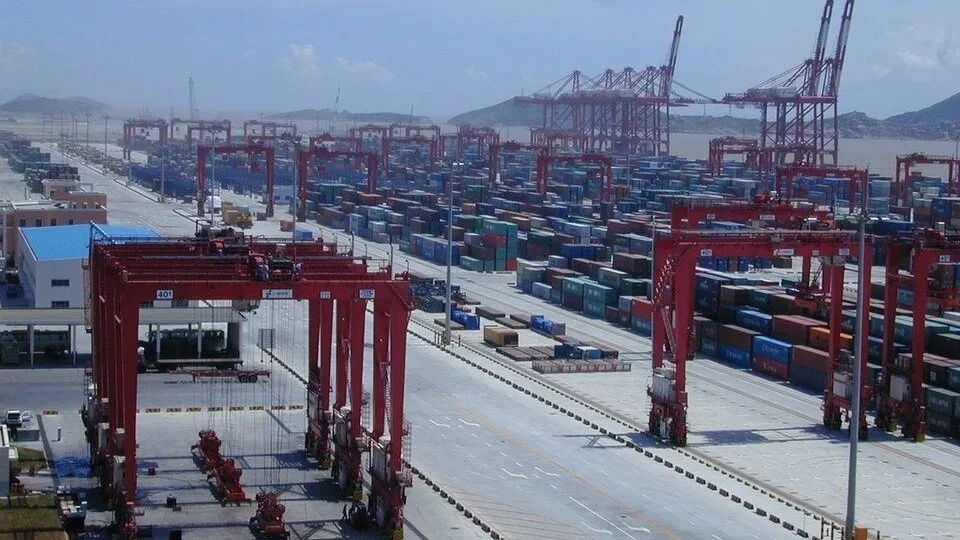
Photo: Chinese cargo terminal, Shanghai, public domain, wikimedia commons
The South Dakota Standard is offered freely and is supported by our readers. We have no political or commercial sponsorship. If you'd like to help us continue our mission to advance independent political and social commentary, you can do so by clicking on the "Donate" button that's on the sidebar to your right.