
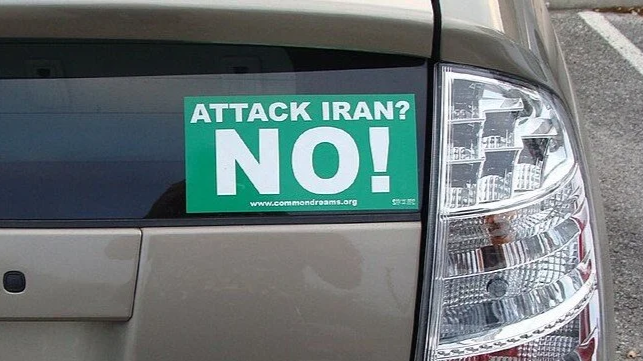
Bumper stickers, funny or provocative, are the original social media
Editor’s note: This was earlier published in the Wyoming Tribune-Eagle and other regional newspapers. The Standard thanks Ms. Hasselstrom for letting us share it here.
“You’ll be lucky to get out of South Dakota alive,” the professor said, nodding at my bumper sticker. He smiled, adding, “I may be kidding.”
This was not my first warning that my bumper sticker might be dangerous, even in my home state of South Dakota. Leaving that small college campus, I was thoughtful.
My cars have carried the same message for years, with replacements from an organization that provides every possible political view in bumper stickers, pins, and posters. I have given extras stickers to bank tellers, gas station attendants and fast-food servers who asked for one.
I consider bumper stickers as entertainment and enjoy reading them on long road trips, a way of sharing a joke with a stranger. One of my all-time favorites is “Pass with Care: Tobacco Chewer,” spotted on a pickup driven by a voluptuous blonde woman in Wyoming. For that one, Playboy magazine paid me 50 bucks, one of my first writing sales – and possibly still the most I’ve ever been paid per word for writing.
Surely, I thought, no one takes bumper stickers seriously enough to kill over. Still, a lot of folks these days seem ready to commit violence in disagreements.
In South Dakota, neighbors have known me for 50 years, know I pay my bills and contribute to charity so they may understand that the bumper sticker doesn’t tell the whole story. But lately, in city traffic, drivers behind have honked, shaken fists, even bumped my car. I mumbled nervously, “Go ahead; hit me and I’ll sue you.”
One driver screamed that God would punish me and waved his hand with a particular digit upraised, a gesture I’m pretty sure God doesn’t use. Another howled that God loved me even though I obviously was worthless. By mail, I received a photograph of my car; no message, no return address. But I felt the threat was clear. One day when I was 1,000 miles from home another driver hailed me in a parking lot and said, “I recognized you by your bumper stickers.”
Americans are tense, shouting and waving our fists a lot – but could someone really kill me because they think they disagree with my opinions – as reflected in a bumper sticker?
Then a woman from Tennessee called to tell me her friend’s teenage son was killed on his bicycle in a drive-by shooting. Police investigated every aspect of his life and finally concluded he was killed because of the slogan on the T-shirt he was wearing: the same words are on my bumper.
Could that happen in the West? I wondered. Out here we say we judge folks by their actions. The world is too complicated to make snap judgments or decisions by slogan. Our beliefs and attitudes are shaped by a lifetime of thoughtful responses to experience. No intelligent political philosophy can be summarized in three words.
Unfortunately, some folks act and react with dangerous speed and examples of road rage abound.
My bumper sticker reads “Born Again Pagan.”
As a writer, I know the word “pagan” is Latin for “country dweller,” a term originally applied to folks who lived too far out of town to attend church regularly. The term referred to their location – not to their religious orientation. Worse yet, some folks associate the term with Satanism. Writers have to be picky about word usage and I consider the sticker to be a signal that I am not giving in to the sloppy thinkers who define “pagan” as one who opposes religion. The word’s meaning has nothing to do with my church attendance, which is no one else’s business.
The slogan is also particularly appropriate because I am a rancher, a person who prefers to live in the country. In our household, there was always tension between my churchgoing mother and my father, who frequently mentioned that he had a ranch to run, even on Sunday. He believed God would be pleased that he was taking care of His creation if he didn’t make it to church. My mother and I usually went to church alone. As a writer, my work centers on these ranching roots and my deep concern for the landscape on which my family makes our living. Like my father, whether I go to church or not, I have always assumed that I might please God by my concern for the only world we have.
Once I moved to a Wyoming city, the message took on new ironic meanings. I had been reborn to a new city life, but could hardly wait to be born yet again by going back to the ranch. So the bumper sticker seemed to fit the unique circumstances of my life.
If necessary, I am perfectly willing to die defending some of my beliefs and the things I love. But I’m not ready to be shoveled under because some moron judges me by my car bumper. So “Born Again Pagan” is gone.
I still have my T-shirt. And my car still announces “My Other Car is a Broom.” Do you think we have enough sense of humor left for that one?
© Linda M. Hasselstrom
South Dakota rancher Linda M. Hasselstrom writes poetry and nonfiction. She is the winner of numerous awards.
Photo: public domain, wikimedia commons
The South Dakota Standard is offered freely and is supported by our readers. We have no political or commercial sponsorship. If you'd like to help us continue our mission to advance independent political and social commentary, you can do so by clicking on the "Donate" button that's on the sidebar to your right.
Follow us and comment on X and Bluesky