
Despite Trump’s tariff overkill, the trade deficit is as big as ever. His team is collectively delusional on this
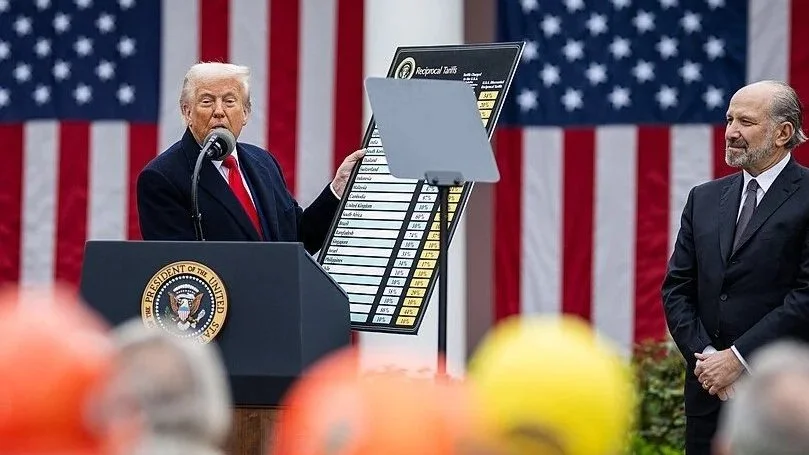
For all of President Trump’s campaign rhetoric and bellicosity about getting the U.S. trade deficit under control, actual numbers are exposing the futility of his efforts.
In a reality-defying post on Truth Social a few days ago, Trump claimed that the balance of trade deficit fell by 78% last year. That flight of fancy is brought down to Earth when you look at the actual numbers. The reality is that the year-over-year drop was negligible, coming in at $901.5 billion compared to $903 billion in 2024.
So how is Trump’s claim misleading? Analysts explain that Trump came up with the 78% decline number by comparing the January, 2025, monthly deficit of $131.4 billion, to the October, 2025, monthly deficit of $29.4 billion, which indeed makes for a 78% reduction.
Cherry-picking monthly deficits and saying they’re reflective of the entire year is the same claim he made during a recent speech in Iowa. It was just as misleading then as it is now.
More problematic for Trump is that since that October number, the deficit has gone up substantially. In November the gap widened by 95%, to $56.8 billion. Then, In December, 2025, the trade gap widened by 32.6% from November, to $70.3 billion.
The trend is not Trump’s friend and you can probably look for it to continue when January numbers are reported. Investment advisory firm roic.ai calculates a January, 2026, deficit of $153.3 billion.
What’s more, discouraging as the numbers are, trade deficit reduction hasn’t been the only flop coming out of Trump’s tariff fixation.
In addition to the so-far elusive drop in trade deficits, Trump promised that his tariffs would create manufacturing jobs. That turned out to be wishful thinking. The Wall Street Journal headlined earlier this month “U.S. Manufacturing Is in Retreat and Trump’s Tariffs aren’t Helping.” Yahoo!Finance reports that since last April’s tariff announcement, 72,000 manufacturing jobs have been lost in this country.
And, indeed, this isn’t just about manufacturing jobs. The overall unemployment rate went from 4% in January 2025 to 4.3% in January 2026.
Things haven’t panned out by now, so perhaps somewhat by mollification, the administration keeps claiming that tariffs are bringing money into the United States, money from somewhere other than America. But that just isn’t true. Stubbornly self-deceptive, his administration refuses to accept the fact that American companies and consumers are paying for them. In keeping with the administration’s self-delusory grip on this fiction, Trump’s own key economic advisor Kevin Hassett just rejected the findings of a New York Fed study concluding that American’s are ponying up for the tariffs. Hassett even said that the authors of the study “should be disciplined.”
This is crazy. Every reputable source I’ve found reached the same conclusion as the New York Fed, and that even goes for the Congressional Budget Office, quoted in Morningstar as saying, "U.S. businesses will absorb 30% of the import price increases by reducing their profit margins; the remaining 70% will be passed through to consumers by raising prices."
The Trump administration seems collectively delusional on all things related to his beloved tariffs.
John Tsitrian is a businessman and writer from the Black Hills. He was a weekly columnist for the Rapid City Journal for 20 years. His articles and commentary have also appeared in The Los Angeles Times, The Denver Post and The Omaha World-Herald. Tsitrian served in the Marines for three years (1966-69), including a 13-month tour of duty as a radioman in Vietnam. Republish with permission.
Photo: public domain, wikimedia commons
The South Dakota Standard is offered freely and is supported by our readers. We have no political or commercial sponsorship. If you'd like to help us continue our mission to advance independent political and social commentary, you can do so by clicking on the "Donate" button that's on the sidebar to your right.
Follow us and comment on X and Bluesky