
The Battle of Greasy Grass at Little Bighorn … and children’s voices
Lakota youth lazily swung their legs over the back of the flatbed truck carrying them to the corrals where their horses grazed. As they bumped along the grassy road, they sang in their traditional Lakota language. I looked up from my place beside the tipi where I had been staying and smiled and waved at them.
How do you know you’re in the right place?
When the children feel safe enough to sing.
The scene happened at a campsite set up by the Cheyenne River Lakota people near the Little Bighorn Battlefield National Monument in Montana during the 150th commemoration of the Battle of Greasy Grass in late June.
My Sun Dance family — the Vances, Benoists and friends from Australia, the West Coast and some friends from Lincoln — visited the commemoration for several days in June. And then we traveled back to Cheyenne River for our ceremony.
Both experiences reminded me of what life must have been like for our ancestors and offered me a vision of what we might still remake.
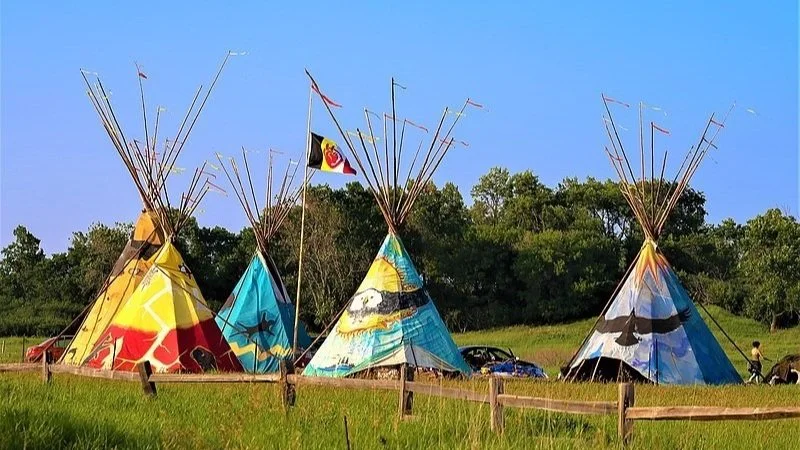
At a large campground down the road from the Cheyenne River campsite, dozens of tipis stood in a field surrounded by trees. One evening, a few friends and I ventured to that campground, where we witnessed our Cheyenne relatives taking part in a stomp dance. Hundreds of people participated and watched the dance, which took place around a circle of singers hovered over a large drum.
I didn’t want to walk away from the celebration, but I also didn’t quite feel like it was mine to enjoy, as much as the Lakota and Cheyenne have long considered each other allies and relatives having fought together against the Seventh Cavalry in 1876. I felt called to my own people, who took part in a round dance just a few tipis away and who then hosted a ribbon skirt contest, followed by what I presume was a snake dance.
A tall man with thick black hair that hung freely past his waist led the dance, which included at least 50 participants who wound their way around tipis as a drum group sang. Children laughed and everyone swayed to the music. The man swung his head this way and that and danced adeptly to the beat of the drum.
The dance ended with the participants swirling around the man. As they circled him, they danced faster as the drum rose in timber and speed. The man smiled in pure joy as the people spun around him.
The people loved the man because the man loved the people.
My Sun Dance leader Steve Vance is also such a man. He is a revered Lakota elder who has spent his life bringing back the ancient ways of his people and preserving what remains of Lakota spiritual customs. Someone who firmly believes in the power of prayer and the nobility of sacrifice.
These are some of the examples of male leadership I find myself pondering as of late. I can’t speak for female leadership, but there are certainly women in these places I’ve traveled who clearly prove themselves each day to be irreplaceable to their tiospayes.
There are still places in this world where we can go to find good, strong, reverent people who care and love one another and who sacrifice each day to ensure the survival of their families and their people. Of course, there are such places and people right here in Lincoln and Nebraska.
But sometimes I find myself drawn to the not entirely tamed Indigenous communities of the Great Plains in order to be reminded of who I am and why I fight to share our stories and uplift Indigenous voices — to inspire our people and give our children hope.
We’re still here. We aren’t going anywhere America. You’ve had 250 years to erase us. You haven’t succeeded and you never will.
How do I know this? I know because our children feel safe enough to sing.
Kevin Abourezk is the deputy managing editor of Indian Country Today
and an award-winning film producer who has spent his 24-year career in journalism documenting the lives, accomplishments and tragedies of Native American people. He holds a bachelor’s degree in English from the University of South Dakota and a master’s in journalism from the University of Nebraska-Lincoln.
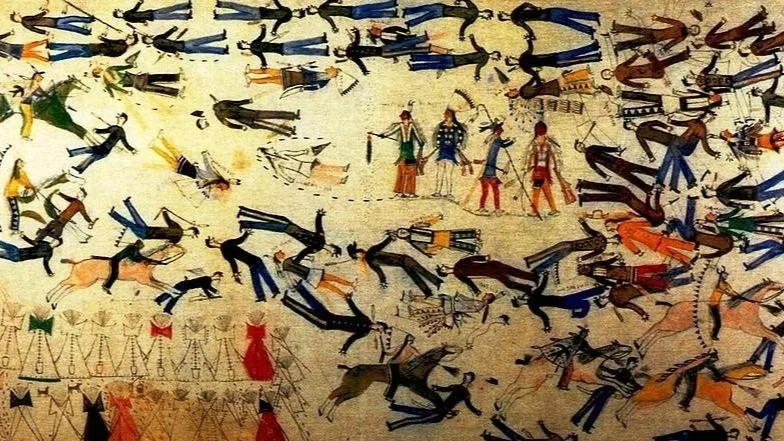
Photo: Battle of Little Bighorn, 1898 painting by Sioux chief Kicking Bear, public domain, wikimedia commons
The South Dakota Standard is offered freely and is supported by our readers. We have no political or commercial sponsorship. If you'd like to help us continue our mission to advance independent political and social commentary, you can do so by clicking on the "Donate" button that's on the sidebar to your right.
Follow us and comment on X and Bluesky