
Farmers are hurting thanks to Trump’s apocalyptic screw-ups
Trump’s farm policy screw-ups are getting expensive. Another federal cash bailout, this time to the tune of $11 billion, was announced in June, effectively demonstrating once again that farmers can’t make it under the strain of his failed ag policies.
That’s frustrating if not altogether maddening, but before I go on, I want to make it clear that I support giving farmers direct cash assistance when their livelihoods are threatened by disasters and policies that go awry. If you know the history of President Jimmy Carter’s 1980 grain embargo against what was then the Soviet Union, you’d know what I mean. Our nation’s farm economy collapsed, with Carter’s embargo serving as the catalyst by forcing crop prices down to disastrous levels. Old hands know the 1980s farm crisis well. It demonstrated that we need financially solvent farmers as a matter of national security, period.
I believe that today’s tough farm economy, in regular need of federal cash infusions, is the result of a disaster that has a specific name attached to it: Donald Trump. Unlike most disasters, this one was utterly foreseeable. Rural voters were nonetheless responsive to his rhetoric and supported him solidly in 2024.
‘Serves them right’ might be the knee-jerk reaction to their current plight, but political judgement notwithstanding, a rural economy in financial distress is ultimately harmful to the rest of the country. Farmers need help.
For that reason, none of us should begrudge the $11 billion farm aid package that Trump requested last month. That amount is on top of the $12 billion that he’s already disbursed in 2026. Added to the $28 billion in aid that Trump gave to farmers during his first term, this president, because of his cockeyed trade and economic policies, has been forced to hand over $50 billion in cash assistance to our country’s farmers during his tenures in the White House.
Is this what candidate Trump meant by promising “so much winning?”
That flippant campaign pledge hasn’t been fulfilled generally, nor in the ag economy specifically. Indeed, the word “crisis” is frequently applied to the plight of farmers these days.
The compelling question at this point is, how long will it last?
My answer? For a long time. I believe that Trump has done fundamentally structural damage to the American farm economy and that some issues will never be resolved.
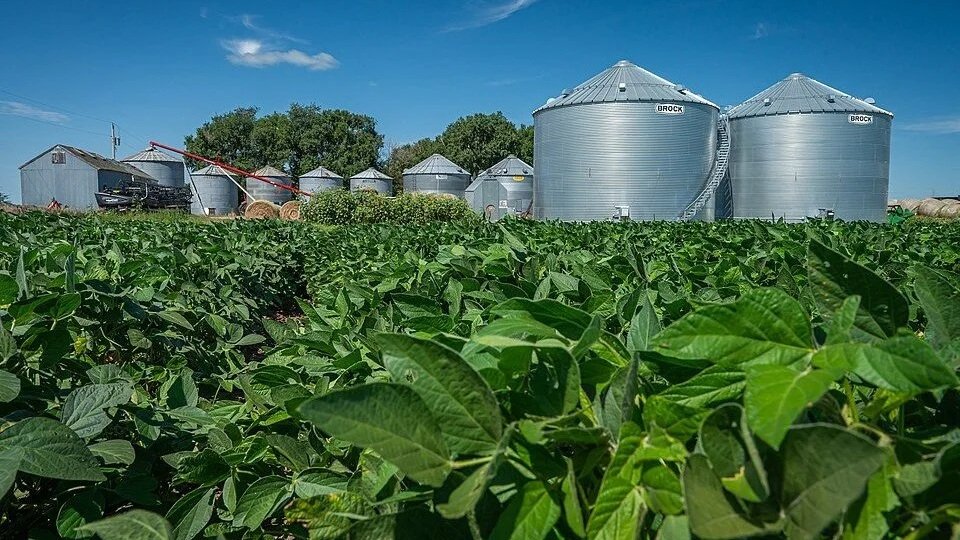
The loss of global markets is one of them: This seems irreversible. Trump’s trade wars and tariffs with China have severely cut exports, not just for the short term, but permanently, particularly when it comes to soybeans, a major crop in a farm state like South Dakota. Market uncertainty has allowed competitors like Brazil and Argentina to grab foreign market share and build up their production. The change in market share since Trump first entered the White House has been startling. According to CNBC, a decade ago, the U.S. and Brazil each accounted for around 40% of China’s soybean imports. Since 2018, Brazil started taking a much bigger share. As of the first five months of 2026, more than 60% of China’s soybean imports came from Brazil, 23% from the U.S. and 10% from Argentina.
Rising input costs is another: I hope this one is more flexible and less structural than the soybean situation, largely because changes can come about through policy. In a piece cheekily titled “Whom should farmers believe: The President or their lying eyes?” that doyenne of conservative thought, The Cato Institute, says “the Trump administration’s 2025 International Emergency Economic Powers Act (IEEPA) tariffs are inflicting serious damage” to farmers and further notes that “fertilizer, steel, aluminum, and other inputs increase production costs while foreign retaliation reduces exports and puts downward pressure on commodity prices.” In other words, farmers are getting shafted from both ends.
Market consolidation is also part of the picture: Trump’s policies are accelerating the process of consolidation, as that is the only practical way to absorb rising costs. Small to non-existent profit margins and rising operating costs disproportionately harm small and mid-sized operators. Thanks to Trump, the loss of family farms will spillover into rural communities that will see their populations continue to decline.
I recently noted here that Trump’s favorability in rural districts has fallen sharply. In recent months his net approval has declined 34 points. Since 2025, it has gone from +20 to -14. His love affair with rural America has soured.
I think that’s most likely because the effects of his policies on rural economies are probably irreversible. He’s already had to shore up our farm sector with $50 billion in cash payments, and there’s no end in sight as long as South America has become an agricultural powerhouse that has stolen so much of our market.
To me, this is something more than transitional. I think it’s apocalyptic.
John Tsitrian is a businessman and writer from the Black Hills. He was a weekly columnist for the Rapid City Journal for 20 years. His articles and commentary have also appeared in The Los Angeles Times, The Denver Post and The Omaha World-Herald. Tsitrian served in the Marines for three years (1966-69), including a 13-month tour of duty as a radioman in Vietnam. Republish with permission.
Photo: public domain, wikimedia commons
The South Dakota Standard is offered freely and is supported by our readers. We have no political or commercial sponsorship. If you'd like to help us continue our mission to advance independent political and social commentary, you can do so by clicking on the "Donate" button that's on the sidebar to your right.
Follow us and comment on X and Bluesky