

USD law prof: Federal agents may be protected from civil suits, but local officers helping them could be in jeopardy
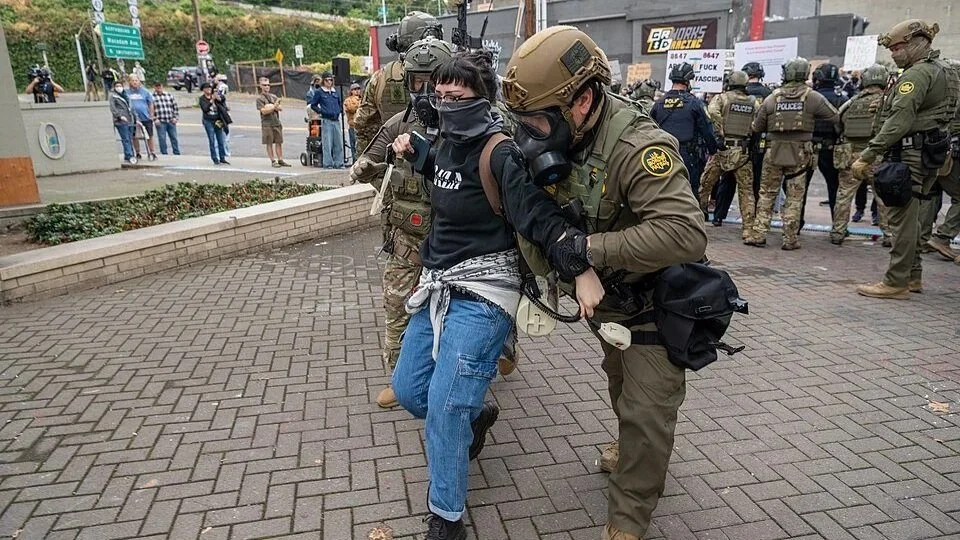
This essay is the second in a series of two examining civil remedies for constitutional violations at the hands of law enforcement officers. The first essay examined the partial immunity of federal law enforcement officers under the Federal Tort Claims Act. This essay considers state police assisting with I.C.E. actions — along with other local government agencies such as universities, schools, libraries, and so on.
It’s difficult — though not impossible — to bring civil suits against federal law enforcement officers under the Federal Tort Claims Act (FTCA). Attorneys are wary about bringing them for at least two reasons: No attorneys’ fees can be recovered from the government; and federal officers can claim immunity if they were exercising discretionary functions in doing their job (the “discretionary-function” exception to liability).
The biggest hindrance to vindicating civil rights violations committed by federal officers, however, isn’t with the vague and poorly mapped “discretionary-function” defense but rather the inability of a prevailing plaintiff to recover their attorney’s fees. The absence of a “fee shifting” statute to permit the recovery of attorneys’ fees means that unless the attorney is willing to work for free, either the client must shoulder the fees or the attorney must rely on a contingency fee arrangement.
Take the case of an Immigration and Customs Enforcement (ICE) officer shoving an onlooker into oncoming traffic and causing her $3,000 in hospital bills. With pain and suffering and little lost work, maybe the damages total $30,000. If the attorneys’ fees expended in achieving that recovery totaled $50,000, the client doesn’t recover much. In fact, she has a net loss of $20,000. It doesn’t make much sense to spend $5 to recover $3.
If, alternatively, the attorney offered a contingency fee of one-third, the attorney recovers just $10,000 and the attorney has effectively lost $40,000.
Actually, it’s worse than that because the FTCA caps contingency fee agreements at 25%. The economics of moderate-damages FTCA cases are just too skewed toward the defendants.
Thus, as a practical matter, no lawsuit alleging constitutional violation or tort by I.C.E. will be brought unless the monetary damages sustained by the citizen approach six figures. As a result, ICE can act with impunity knowing that no one will sue them for being shoved to the concrete. Or snatching a phone. Or breaking into homes without warrants. Impunity is equivalent to practical immunity.
Due to the FTCA’s lack of fee-shifting, ICE agents enjoy practical immunity for anything but the most egregious and catastrophic violations of constitutional rights. For relatively minor violations (say, breaking the arm of a protestor without cause) they have a free pass. It’s just too expensive to sue them.
Suing state or local police officers is tough too, but not as tough. State actors enjoy an immunity defense as well, although attorneys’ fees can be awarded if the claimant is successful. This means that even if the individual did not suffer catastrophic injuries (a big dollar recovery), an attorney is more likely to undertake a vindication of the individual’s rights because the government can be required to pay the claimant’s attorneys’ fees, assuming the claimant prevails.
Nowadays, we are seeing more and more active cooperation between state and local law enforcement. Some schools and universities are also actively cooperating with I.C.E. And we are seeing more and more blatant constitutional violations by federal officers.
And so, the question naturally arises:
Do city, county, or state agencies enjoy immunity for actively assisting I.C.E. when a raid goes bad, an unsupported arrest is made, or a human being gets shot?
Section 1983 allows for individuals to recover for constitutional violations carried out under “color of state law.” It was the legal basis against the South Dakota Highway Patrol when one of their officers slammed a DUI suspect to the ground without cause a few years ago
State and local police enjoy “qualified immunity” under section 1983. Federal officers cannot be sued under section 1983 at all. But if state or local police are “conspiring” with federal officers to commit constitutional deprivations, then, as a 46-year-old law review article suggests, a “derivative liability theory” (recognized in several courts) would expose state agencies to liability under 1983 even if the federal officer counterparts were immunized under the FTCA.
Cooperation with ICE might trigger liability for state agencies even when it is ICE. — and not the locals — committing the wrongs.
The news reports of ICE conduct suggest a widespread and even institutionalized level of constitutional violations, specifically the 4th Amendment. When Alex Pretti was pepper sprayed, then pummeled while down with a rain of blows, then shot, Secretary Noem asserted that the ICE officers “responded according to their training.” If this is what ICE agents are trained to do, local agencies should seriously consider the financial risks of associating with them.
While it is now unclear whether ICE did in fact arrest and detain four homeless Oglala Lakota tribal members earlier this month, it’s hard to imagine that there was probable cause to believe they were undocumented aliens simply based upon having brown skin and having no identification papers on their persons. Nor does the Fourth Amendment permit individuals to be detained just because they have a roofing job or were born overseas.
As clear indications of systemic constitutional violations by ICE continue to circulate, a state officer or police agency would have a rather difficult time arguing they were ignorant of ICE attempts to commit 4th or 5th Amendment violations. And that would make it that much more difficult to defeat a claim that local agencies conspired with the Department of Homeland Security when they offered their cooperation and assistance to do what ICE is doing.
ICE might escape liability for its constitutional infractions, but local law enforcement assisting them might not. Section 287(g) agreements between ICE and local police departments might be just what plaintiffs need to pin ICE violations on state actors. As Vice President JD Vance pushes for more active cooperation from local cops with ICE, fiscal conservatives should sound the alarm about the potential liability from the civil lawsuits that may follow.
Thomas E. Simmons is a professor at the University of South Dakota Knudson School of Law in Vermillion. His views are his own and not the views of USD, its administrators, or the South Dakota Board of Regents. The opinions expressed above are those of a private citizen.
Photo: public domain, wikimedia commons
The South Dakota Standard is offered freely and is supported by our readers. We have no political or commercial sponsorship. If you'd like to help us continue our mission to advance independent political and social commentary, you can do so by clicking on the "Donate" button that's on the sidebar to your right.
Follow us and comment on X and Bluesky