
On Doeden’s plan to repeal property taxes – a few modest proposals
Editor's note: this is the first installment of a multi-part series that will appear periodically during coming weeks.
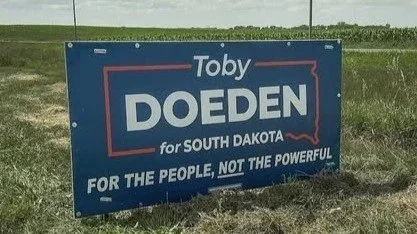
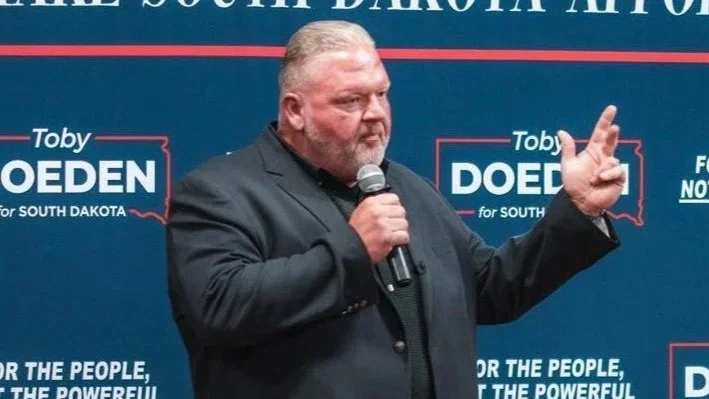
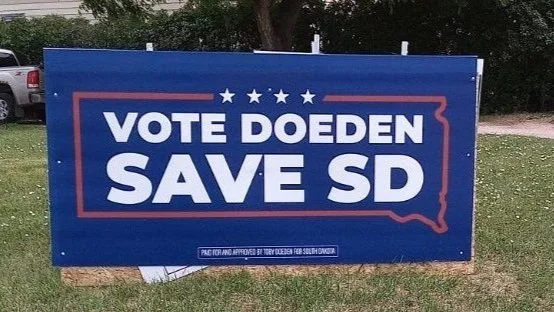
The idea of repealing property taxes is becoming more and more popular in South Dakota — and nationwide, too. It may be one of the chief reasons for gubernatorial candidate Toby Doeden’s exceptional performance in the GOP primary on June 2. His platform in this regard is summarized on his website:
“Toby Doeden will fight to reduce and ultimately eliminate your property taxes, so that you can raise your family, operate your farm or ranch, and grow your business free from crushing property taxes.”
Republican Jeffrey Church, a retired colonel (and particularly bright former student of mine), challenged (unsuccessfully) a state Senate seat held by Sydney Davis in District 17 on June 2 as well, having floated the same idea. A group has proposed a state constitutional amendment to replace property taxes with a flat retail transaction tax. (It won’t be on the ballot this year as their signature count fell short.)
Meanwhile, in Florida, Gov. Ron DeSantis is spearheading a proposal to allow local governments to exempt a taxpayer’s principal residence from property taxes up to $250,000 in value. Reportedly, Ohio and Georgia are also eyeballing a repeal of property taxes.
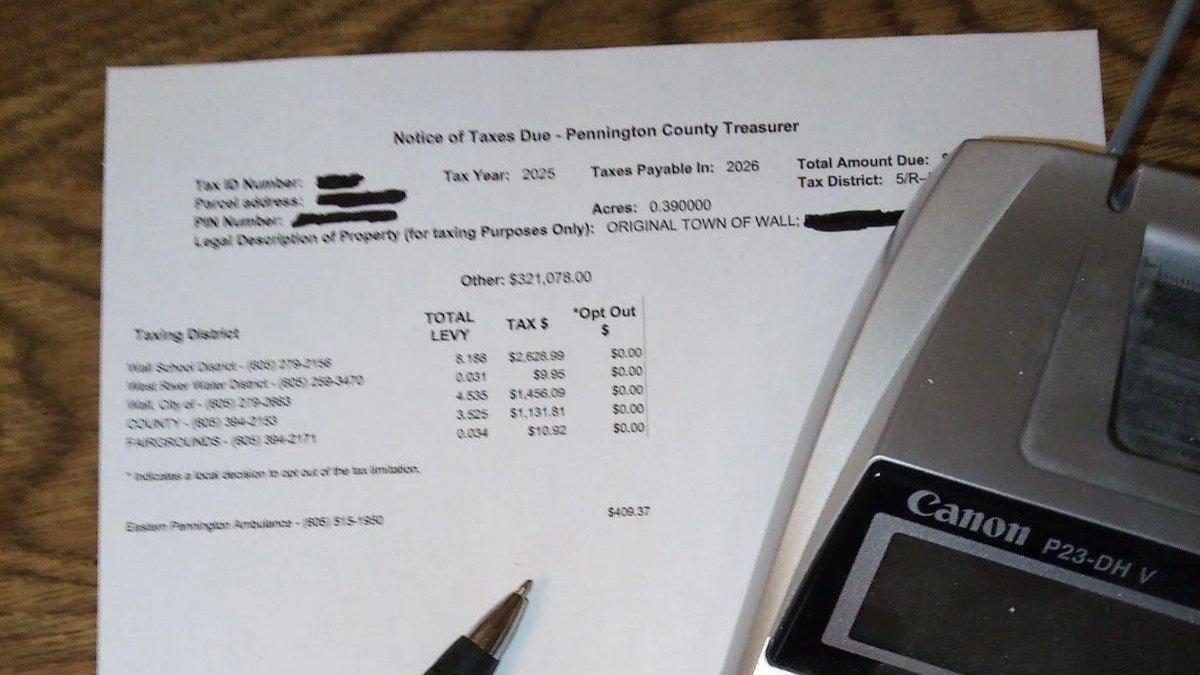
In South Dakota, property taxes generate just north of $1.5 billion in revenue each year.* The portion of that cash that goes to the state government, however, is less than that.
Way less. It’s zero.
South Dakota’s property taxes mostly fund local school districts. The rest goes to county and city governments to pay for things like snow removal and law enforcement salaries. The money stays local. It’s spent by local governments.
So, the simplest plan to repeal property taxes would be to eliminate local governments. End city and county governments. Townships, too. Oh, and to dissolve every school district in the state.
Problem solved.
Admittedly, though, that might not generate a sufficient degree of popular support. Some people like having their local courthouse, a prosecutor who can convict criminal offenders, and a jail to which to sentence them. Some people even like high school sports. And high schools. Some have grown accustomed to city parks and streetlights. And streets. A lot of us rightly value a lot of these things.
Is there anywhere else to cut spending? Well, coincidentally, the amount spent annually on the Medicaid program in the state is almost exactly equal to the amount collected by property taxes. Eliminating the Medicaid program is certainly possible; it’s a program that the feds basically match in contributions. It’s a voluntary program; no state is required to participate.
South Dakota could withdraw relatively seamlessly. Then the savings could be distributed to local governments in lieu of their property tax revenues.
Problem solved.
Certainly, there would be consequences in deleting Medicaid, but no one should expect to be able to allow taxpayers to retain $1.5 billion each year** without having to cut somewhere. If we withdrew from the Medicaid program, a lot of elderly and severely disabled persons would need to move in with their families. (Medicaid pays for about half of all nursing home residents’ costs.) And someone in the family may have to quit their job to provide grandpa with 24/7 homecare.
In addition, a lot of low-income parents’ babies and children would go without any medical treatment. Low-income pregnant women would have at-home births. To quote King Farquaad from the movie “Shrek,” “Some of you may die, but it’s a sacrifice I am willing to make.”
I might venture a guess that the Medicaid-elimination idea would also generate a less than enthusiastic response from South Dakotans. I mean, the voters just approved a measure to expand Medicaid (by 56%).
If only we could make up the loss from doing away with property tax revenues somewhere else …
OK, I’m just spit-balling here, but let’s take Mount Rushmore as an example. Over 2 million tourists visit it every year. If my math is right, all we have to do is charge every visitor $750 to generate $1.5 billion.
Sure, there would be some sticker shock. A family of four would pay $3,010 (that’s $750 x 4 + $10 for parking).
Does anyone see a potential flaw with this plan? Is it reasonably foreseeable that more families would elect to see the four faces from the windows of a moving car if they were eyeballing an admission fee of three grand just to get a little closer? I mean, even Bear Country (which I’ve always considered kind of pricey — worthwhile but pricey) is only $90 for a family of four.
Yes, indeed, we would expect attendance at the memorial to suffer if a $3,000 admission fee were imposed. Maybe we would expect a drop of 80% or more visitors.
But no worries, we can adjust the admission fee to account for that. If attendance drops from 2 million to 400,000 visitors a year, the admission fee just needs to be hiked to $3,750. Not $3,750 per family, $3,750 per person. So, that would be $15,010 for a family of four (after accounting for the $10 parking fee).
There we go. Problem solved.
I can hear the mumbling in the back of the room already. Yes, Virginia, there will be an additional drop in attendance if the cost is $15,010 per family. Maybe only 1,000 people would visit the faces each year; the one percent-ers. Meaning, we’d have to charge those 1,000 visitors a million and a half apiece; $5 million for a family of four. But maybe at that rate it would make sense to just waive the parking fee.***
Is there another way? Well, Toby Doeden has a solution brewing. Some of his plan would be to tax tourists, and not just those visiting Mount Rushmore. He’d also levy charges against banks and trusts. Would it work? Stay tuned.
*About the price of a billion-dollar ballroom, after accounting for the expected cost overruns. (The reflecting pool upgrade that was quoted at $1.8 million is so far up to “less than $20million.”)
**Technically, the total Medicaid expenditures in South Dakota were $1.55 billion in the last year reported (2024) but the state only had to cover a tad under half a billion; the federal government contributed the other $1 billion. So, if we eliminated the Medicaid program it would actually only save the state 1/3 of the amount we would lose in repealing property taxes
***Some well-heeled folks paid $2 million a head to see Les Misérables at the Kennedy Center recently, so $1.5 million per head to go to Mount Rushmore is not inconceivable.
Thomas E. Simmons is a professor at the University of South Dakota Knudson School of Law in Vermillion. The views and opinions are those of the writer and not those of the University of South Dakota, its Knudson School of Law, or the South Dakota Board of Regents.
Photo: John Tsitrian
The South Dakota Standard is offered freely and is supported by our readers. We have no political or commercial sponsorship. If you'd like to help us continue our mission to advance independent political and social commentary, you can do so by clicking on the "Donate" button that's on the sidebar to your right.
Follow us and comment on X and Bluesky