
In defense of property taxes, which localize government
This is the fourth in a series of interconnected essays. The first installment can be read here. The second installment can be read here. The third can be found here.
South Dakota is flirting with property tax repeal. There’s some good and some bad when it comes to property taxes. I’d like to highlight the prudence and fairness of property taxes as well as examine some of their inherent harms and injustices. Like many things that matter a lot, a property tax is neither one-sided nor simple.
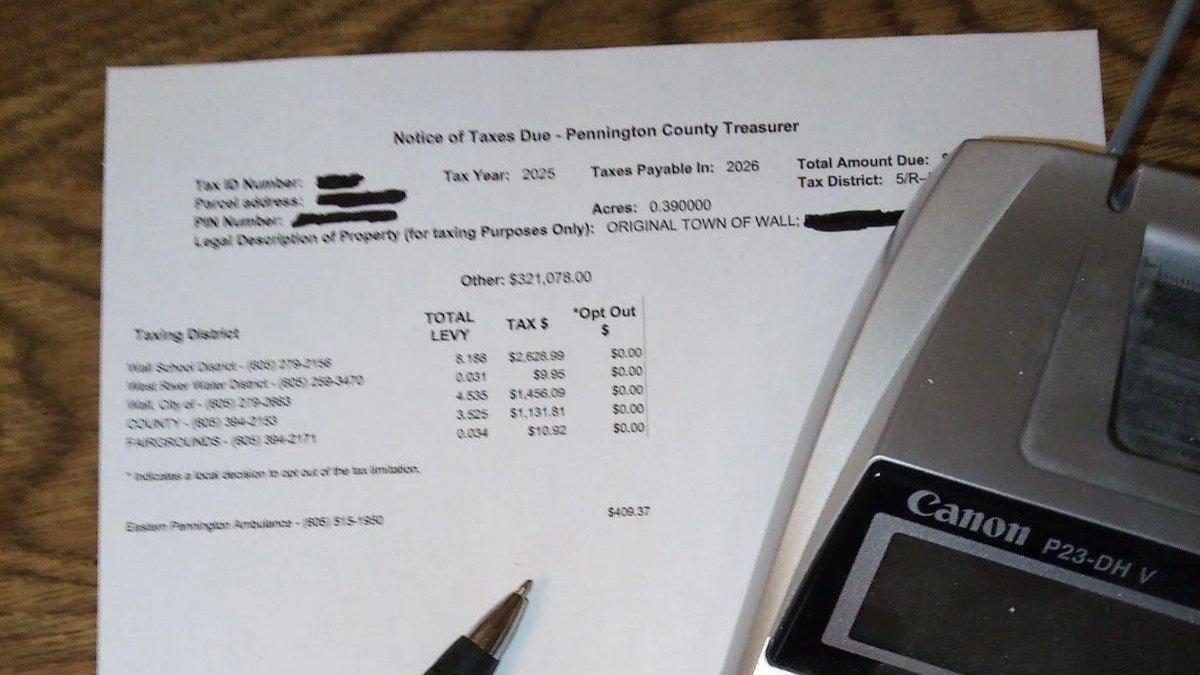
South Dakota employs a real property tax to raise funds for county, city, and school district expenses. Relative to other states, we sit at about the middle of the pack in terms of the ratio of property values to taxes collected. The state with the lowest property taxes is Hawaii.
South Dakota once had a personal property tax, but it was repealed and phased out in 1978-80. The accounting firm of Casey Peterson in Rapid City used to have a framed copy of a state personal property tax return in their lobby. Although a personal property tax is a horse of a different color than a real property tax, the personal property tax survives in the form of vehicle registration fees.
For the privilege of owning a vehicle, trailer, motorcycle, or boat, one must pay a registration tax. It’s an ownership-fee. (More accurately, it’s a tax based on licensure; I could allow my tags on my older Chevy to expire and then own it “tax-free,” I just couldn’t drive it on public roads.)
Presumably, like the gas tax, it’s linked to the wear and tear I put on the state-repaired roads, yet if I own five cars, I pay a lot of tax, even though I can only drive one car at a time. So, there’s some distortion or unfairness with vehicle taxes — as there are with all taxes.
Now, let’s consider property taxes. Is there anything good about property tax? Sure. Here are four:
First, it’s voluntary. If one doesn’t want to pay the tax, tax avoidance is legal and easy: Don’t own realty. To be fair, though, everyone needs shelter and if one rents, one still (indirectly) pays property tax through higher rents. However, not all realty is devoted to shelter. Consider businesses, for example.
Second, property tax revenues are predictable. A steady stream of revenue for government services is preferable to an erratic stream. Sales tax revenues are volatile. Property taxes are stable.
Granted, there are some variations in property tax revenues because some property owners default, some property appreciates (or depreciates), and some property goes into nontaxable status. Where I live, for example, the county purchased taxable property on which to construct a new jail, thereby converting its status to nontaxable. Counties with greater shares of nontaxable property (thinks: Ellsworth Air Force Base and Indian Trust Land) necessarily struggle a bit more with their reliance on property taxes to fund government services.
Still, overall, property tax revenues are relatively predictable because real property is what the law terms an “immovable.” The law didn’t need to tell you that. Try moving an acre of ground into another state. You’ll see what I mean. And contrast this immovability with the extremely mobile nature of certain economic actors — like bar patrons — or financial services like bank and trust accounts.
Predictability is nice for cities, counties, and schools. It’s also good for citizens. No one wants to hire five more teachers and six more firefighters, then fire 10 of each when tax revenues drop. Stability in government revenues is preferable because consistency in government services is preferable.
Most significantly, however, property taxes represent a localization of government taxation. Credit must be extended to Brayden Beaner, a brilliant former student of mine from Garretson, for this insight.
Decentralization of governmental power better preserves individual liberties. It’s more accountable. And it better reflects local cultural mores than faraway leviathans, whether in Washington, D.C. or (a lesser leviathan, to be sure) Pierre. Beware of centralized schemes, imposed from above, warned Edmund Burke. The “little platoons” of county, city, and township governments are not beyond reproach, but they’re much more reproachable.
Localized units — like a township or county board of equalization — are more reproachable because they’re more approachable. It’s a shorter drive to voice a complaint. And if the decision-makers fail in their civic duties they’re easier to vote out of office than to unseat a U.S. senator or generate a reversal from the state Department of Revenue. Hence, they’re more responsive.
Local control also improves governance at higher levels. The strength of a state and “a nation depends on the vitality of its smallest units,” agrees Greg Schaller. Three cheers for localism.
Finally, let’s acknowledge that regardless of the justification for a property tax, a separate question can be raised as to the level of the tax. In other words, one might approve of a property tax in theory, yet vociferously object to the level of taxation, even to the extent that one might consider dumping tea over the side of a sailing vessel moored in Boston Harbor.
To be sure, if we want to lock horns with real property taxes, our point might be better made by dumping acres of farm ground into Sutton Bay, but as underscored above, real property is an immovable.
Now let’s consider the criticisms of property tax. I can name three:
First, it’s unfair to pay the government simply for the privilege of owning property, which is a natural right, not a privilege.
Second, we already pay enough taxes relative to real property ownership. If the property generates income, that’s taxed by Congress. If we hire a contractor to make improvements to our property, there are excise taxes. If we sell produce from our garden, sales taxes. If we sell the land for a profit (or even simply because it has appreciated on account of inflation), we pay capital gains taxes. When the property passes to heirs, it may be exposed to the estate tax.
Third, when it comes to a homestead, taxation can strip a citizen of their shelter (or the ability to shelter one’s family) if the taxes go unpaid. Taxation can jeopardize the cohesion of the fundamental human social unit (the nuclear family) on which civilization depends. Property tax relief programs for seniors, veterans, paraplegics, and discounts for owned-occupied homes and ag-land are all designed to ameliorate these injustices.
So, because a property tax is less cyclical than sales tax, and both taxes have their own set of problems, a comprehensive tax structure might employ a thoughtful mix of both, plus some excise taxes and vehicle registration fees. That’s the system we have in South Dakota. It works fairly well. Gov. Rhoden’s tweaks last legislative session provided some prudent reforms and relief to property taxes by allowing recalibrations of local sales taxes.
(Of course, sales tax has its own set of benefits and bummers. One problem with a sales tax is that it is far from progressive; it over-burdens low-income folks. If it’s held in check to a reasonable amount, this effect is softened. Exempting groceries would further rectify the inherent regressiveness of sales taxes. And granting tax breaks to low-income housing developments could be considered as an additional real property tax reform.)
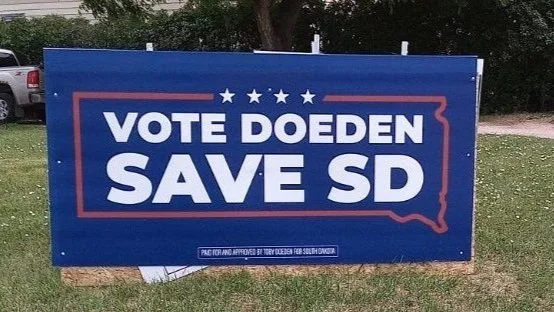
Ultimately, there are problems with every form of taxation. It’s fun to daydream about a world without taxes. Magical thinking doesn’t make for good policy — though it might look like a path to public office. But South Dakota voters are a shrewder bunch than some Johnnies-Come-Lately assume.
Thomas E. Simmons is a professor at the University of South Dakota Knudson School of Law in Vermillion. The views and opinions are those of the writer and not those of the University of South Dakota, its Knudson School of Law, or the South Dakota Board of Regents.
Photo: John Tsitrian
The South Dakota Standard is offered freely and is supported by our readers. We have no political or commercial sponsorship. If you'd like to help us continue our mission to advance independent political and social commentary, you can do so by clicking on the "Donate" button that's on the sidebar to your right.
Follow us and comment on X and Bluesky